
Who Helps Your Crypto Startup Grow Faster?

A top 10 list of crypto growth advisors. You scroll down. Amazing. The firm that wrote it is number one. Waste of time. Close tab. Move on.
Yet it’s a legitimate question worthy of a real answer. Who can help your crypto business grow faster? I asked the question the same way everyone does, I put it to AI. Five AI platforms answered “Who advises DeFi startups on growth?” Of the 62 firms they named, 14 were dead, irrelevant or gone. One was a parked domain for sale. The shortlists barely overlapped. When I asked for the best strategy consultant for a crypto startup in Singapore, the US and Germany, again near no overlap, and the shortlist changed with the country.
I will save you the scroll. I wrote this, and my company is on the list, described the same way. The firms listed advise crypto companies but do not do the same job, so ranking them is meaningless. They deliver seven different ways to help you grow faster.
Deciding who can help
Every firm on this list treats a cause someone has already identified. That works when it is the right one. The decision on who to hire to help normally gets made assuming it is. You decide what is wrong, then hire the firm that can help. The firm gets picked because it sells your solution. It’s an easy sell, the fix is what they do. It can work if your diagnosis is right, precisely right. If not, the wrong call can be very expensive.
As of late October, RootData’s 2026 dead projects list holds 361 crypto projects that have shut down, filed for bankruptcy or gone dark in 2026. Sort it by total funding, and 95 of them had raised USD 2 million to USD 50 million. Those 95 didn’t fail because of a lack of money.
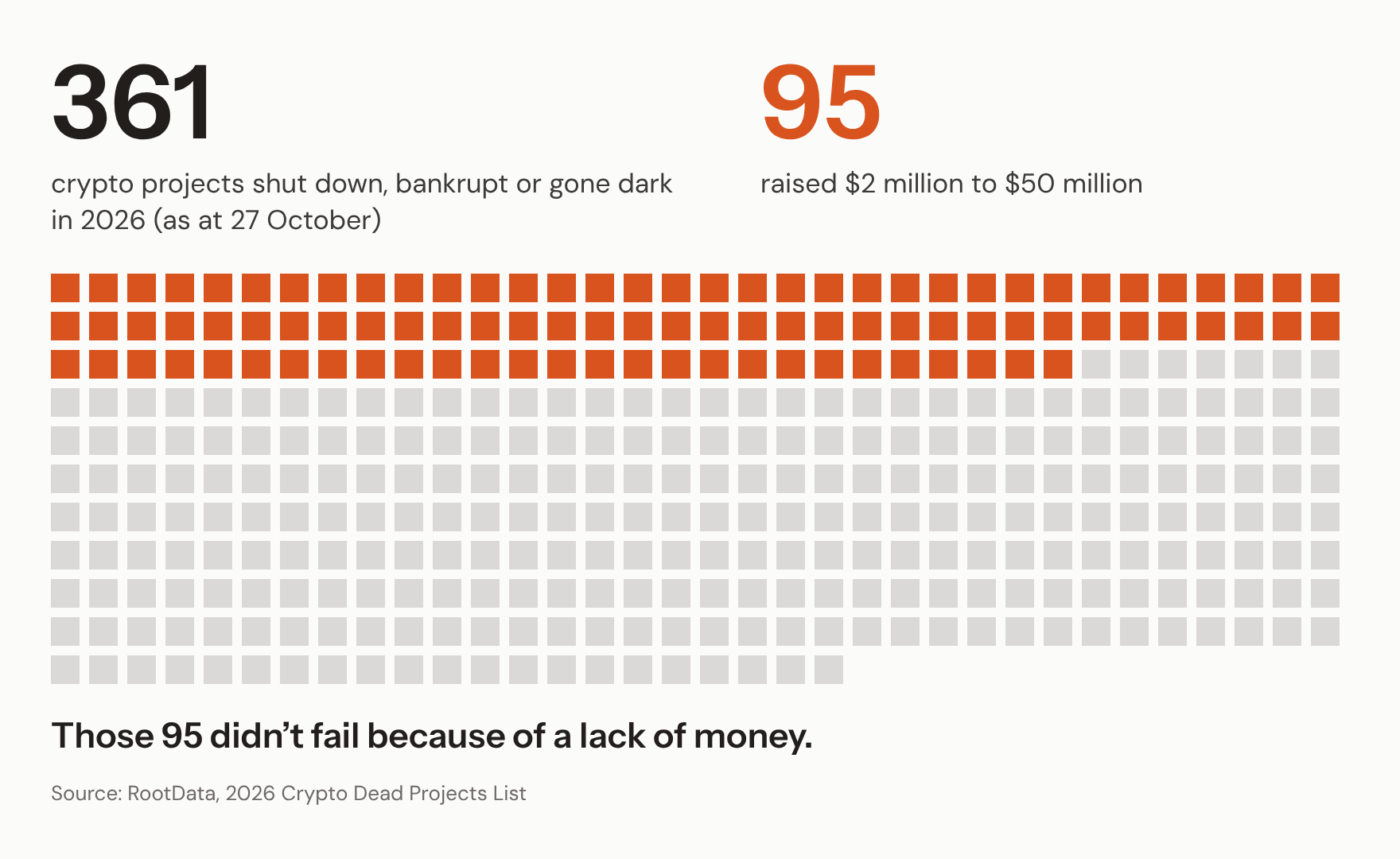
Why do well-funded crypto startups still fail?
I’d put every one of them down to a flawed strategy. A product no-one wanted, a token nobody needed, or a hack that wasn’t defended against, was a decision someone made. Some people will counter that sometimes it can just be bad luck. To me, bad luck bears a striking resemblance to not being prepared for the unexpected. Companies fundamentally fail for one reason. They can’t grow fast enough at the right cost to survive.
Seven kinds of help, and when each is the right call
Of the 48 firms, 18 are marketing growth agencies. That is more than one in three. They are the right call when users already stay. If churn is too high, more marketing won’t fix it. What each group sells is only one part of a company’s strategy, and the right strategy is what drives growth. Fixing one piece can be the right move when you know what the issue is and if how you fix it affects nothing else.
- 18Marketing growth agencies
- 11VC teams
- 7Accelerators and ecosystems
- 5Tokenomics and protocol design
- 5Capital, finance and structuring advice
- 2Directories and marketplaces
- 0Strategy
The firms who help your crypto startup grow faster?
| Right call when | Group | Treats | Of 48 | Named by AI |
|---|---|---|---|---|
| Already know what help you want | 1. Directories and marketplaces | Need to find someone | 2 | Web3Connect, Circle Alliance directory |
| Users already stay | 2. Marketing growth agencies | Too few of the right people know about you | 18 | Coinbound, Surgence Labs, Sphere3Verse, LuvKaizen, GM Growth Agency, GrowShift, Growgami, ICODA, MarketAcross, Serotonin, Wachsman, KodeGrid, Techtonic Marketing, EAK Digital, NinjaPromo, GuerrillaBuzz, The DeFi Edge Ventures, The Group Three |
| Token mechanics are the constraint, need proper modelling | 3. Tokenomics and protocol design | Wrong incentive or token design | 5 | Gauntlet, BlockScience, Economics Design, BlockApex, Forgd |
| Growth capped by balance sheet or structure | 4. Capital, finance and structuring advice | Need money, or better financial or legal structure | 5 | Galaxy, Steakhouse Financial, Sentora, BlockOffice, DeFi Advisors |
| Before product-market fit | 5. Accelerators and ecosystems | Need structure, programme and first cheque | 7 | Alliance, Outlier Ventures, Chainlink BUILD, DeFi.org, Arbitrum, Optimism and Base ecosystem teams |
| Already in their portfolio | 6. VC teams | Strategy, GTM, growth. 5 of 11 describe in-house teams | 11 | a16z crypto, Paradigm, Dragonfly, Framework, Pantera, Polychain, Electric Capital, Robot Ventures, Wintermute Ventures, ACC Ventures, SuperDigital Ventures |
| Unsure of the fix or how to make it work | 7. Strategy | Unknown. Finds what makes you grow faster and designs the company around it | 0 | None of the 48 sells it. 5 VCs do it for their own portfolio only. |
Five questions tell you which row is yours.
- Do the users you have stay? If churn is too high, more marketing won’t fix it.
- Are token mechanics the constraint? A tokenomics firm will model them properly.
- Is the constraint cash you need to raise? Look to the capital group.
- Are you pre-launch and haven’t found product-market fit? An accelerator is built for that stage.
- Does everyone in your leadership team agree what is capping your growth or are any of them not really sure? If they name different things or are not clear, the cause is still unknown.
Strategy for startup founders, once a week
Written by someone who has learned the lessons running them.
Did you mean ?
Newsletter only. Never sold or shared.
Who sells the diagnosis?
Not one of the 37 firms you can hire sells a diagnosis of how to accelerate growth. Each group treats a cause somebody has already identified. That works when you are sure you have the right one. If you are, I suggest going to them. What I add matters more when you’re not entirely sure.
One group does this work. Of the 11 VC teams, 5 describe in-house teams for strategy, go-to-market and growth. They have no price. You can’t buy what they offer, because they only provide it to their own portfolio.
Diagnosis tells you what is in the way and finding it means uncovering the disconnects between three layers; what the leadership team believe, what the metrics and systems show and what users and the market say. I have never run a discovery where they all agreed. And nobody inside the company can see the disconnects, because they are standing in them. That is no failing of theirs, it is a function of being human. The push and pull white noise of daily tasks means the closer you are to the underlying cause the harder it can be to see.
Can your leadership team answer these three questions?
More than two decades as a CEO solving startup growth has taught me that optimising strategy is humbling. The simple, obvious answer almost always leaves you flat on your face. The answer to accelerating growth commonly has multiple factors at play, often interrelated, making seeing them harder still.
Answering three simple questions first can show the way.
- How does your product compel your user to act?
- How do you beat every competitor in your segment?
- What must be true to answer 1 and 2, and can you deliver it?
Clearly answer those first, and the decisions that tie everything else together follow.
My firm, The Startup Blacksmith
I don’t start by assuming I know the answer. The job is to find the real cause, then create the solution that works.
To do that we agree on what is the problem we are solving and what approach best solves it. Mostly it means I lead weeks of discovery across the whole business. I uncover what your leadership team believes and set it against what your metrics and systems show, and what your users and market say. Where those three disconnect, that will be what is capping your growth.
With the evidence, I lead a five-day workshop with your leadership team where you work through and decide the solutions. We answer the three questions first, then work out what the answers mean for positioning, go-to-market, marketing, tokenomics, ecosystem and business development.
On Friday, you have a strategy defined to have you win and the all-of-company roadmap built to deliver it. On Monday, your team gets to work.
The strategy then decides whether you work with the firms above.
Every firm, what each one does and when to use it.
Download the booklet